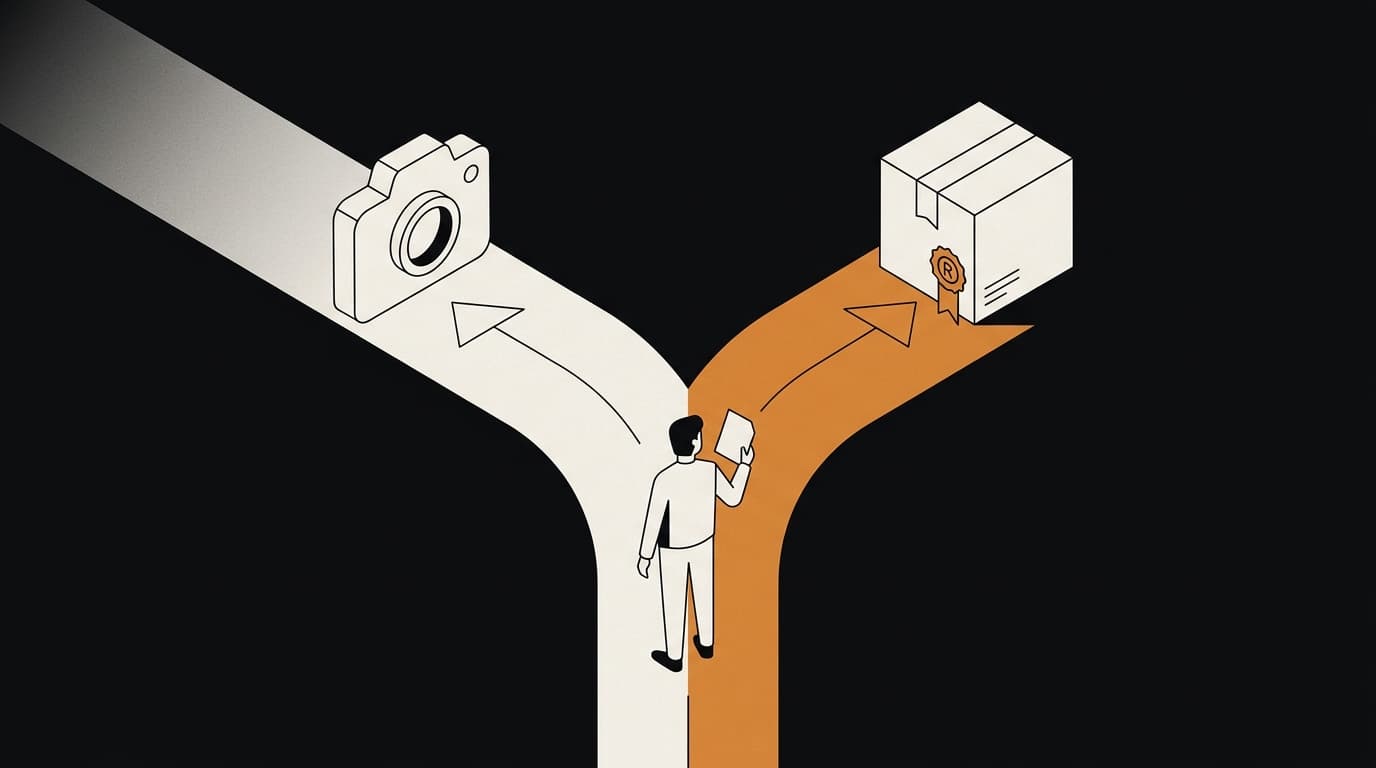
"Send them a DMCA" has become shorthand for any takedown request. It's a useful shorthand right up until you send one against a counterfeit listing and it's rejected, because the DMCA is about copyright, and a counterfeit is usually a trademark problem.
Choosing the right claim isn't a technicality. It decides which team at the platform reviews your notice, what evidence they expect, what the seller can do in response, and what risk you take on by filing. This article explains the difference and how to pick.
This describes how these processes generally work. It isn't legal advice; for your own situation, ask a lawyer.
The short version
| Copyright (DMCA) | Trademark | |
|---|---|---|
| Protects | Original creative work: photos, text, designs, video, software | Brand identifiers: names, logos, slogans, distinctive packaging |
| Typical infringement | Your product photos or description copied into someone else's listing | Your name or logo on goods you didn't make, or used to sell them |
| Legal basis for the notice | US: DMCA §512 notice-and-takedown | No US statutory equivalent; platform policies |
| Registration needed to file | Not for the notice itself | Most platforms ask for a registration number |
| Seller's response | Formal counter-notice | Platform's own appeal or dispute process |
What the DMCA actually does
Section 512 of the US Digital Millennium Copyright Act gives online service providers a "safe harbor" from liability for what their users post, as long as they remove material when they receive a valid notice from the copyright owner. That bargain is why platforms everywhere — including outside the US — run a DMCA-style process.
A valid notice has specific elements set out in the statute:
- A physical or electronic signature of the copyright owner or someone authorized to act for them.
- Identification of the copyrighted work — your original photo, for example.
- Identification of the infringing material and enough information to locate it, such as the listing URL.
- Your contact information.
- A statement that you have a good-faith belief the use isn't authorized by the owner, its agent, or the law.
- A statement that the information is accurate and, under penalty of perjury, that you're authorized to act for the owner.
Platforms build these into their forms, so in practice you're filling in fields rather than drafting a letter.
Two features of the DMCA process matter in practice:
- The counter-notice. The person whose material was removed can file a counter-notice saying it was removed by mistake. The provider then restores it after 10 to 14 business days unless you notify them that you've filed a lawsuit. So a DMCA takedown is quick, but not final against a seller willing to push back.
- Section 512(f). Anyone who knowingly materially misrepresents that material is infringing can be liable for the damages that causes. Filing a DMCA notice you know is wrong — or one you haven't checked — carries real risk.
What trademark complaints do
There's no US statutory notice-and-takedown regime for trademarks. Instead, each platform runs its own process under its own policy: Amazon's Report a Violation, eBay's VeRO, Alibaba's IP Protection Platform, and so on. (In the EU, the Digital Services Act requires platforms to provide a notice mechanism for illegal content, which includes IP infringement, but the forms are still each platform's own.)
Because it's policy rather than statute, details vary — but the shape is consistent. You'll be asked for:
- Your trademark registration number and the jurisdiction it's registered in.
- The goods or services it covers.
- The specific listing, and how it infringes: counterfeit goods, unauthorized use of the mark in the listing, a confusingly similar name, and so on.
- A declaration that your report is accurate.
Platforms also track how accurate each reporter is. Repeated bad reports can cost you access to the reporting tools — see the platform-by-platform guide.
Picking the claim: four common cases
1. A fake product, photographed by the seller, using your logo. Trademark. There's no copyright claim unless something else on the listing is copied.
2. A fake product, sold using your own studio photos. Both. The copyright claim on the photos is often the easier one to make: you own the original image, and the copy is identical. The trademark claim addresses the product itself. Some platforms let you file both in one report; others want them separately.
3. A real product, resold, using your photos. Copyright may apply to the photos. Trademark generally doesn't stop people reselling genuine goods they bought — that's the first-sale principle, with limits that vary by country. Be careful with this case. Reporting genuine resale as counterfeit is exactly the kind of misrepresentation that gets reporters into trouble.
4. A standalone website selling fakes. There's no marketplace, so you're writing to the hosting provider and the domain registrar. Hosts are often more responsive to DMCA notices than to trademark complaints, because the safe harbor gives them a clear reason to act. If the site uses your photos or copy, lead with copyright; include the trademark issue as well. If the domain itself is a lookalike, see UDRP explained.
When the seller pushes back
Most counterfeit sellers don't respond to takedowns; they relist under another account. When one does push back, the route depends on what you filed. A DMCA counter-notice puts a clock on you: if you don't act within the restoration window, the listing comes back. A trademark dispute goes through the platform's own process, which may ask you to respond to the seller's explanation or provide more evidence.
Either way, the decision you face is the same: is this one listing worth escalating, or is it better to log it, watch for reappearance and move on? For a single low-volume seller, the second answer is often the right one.
Before you file either
Both kinds of notice ask you to declare that what you're saying is accurate. The practical safeguard is the same either way: before you file, write down — as a direct quote or screenshot — what on the page makes it infringing. "Replica", your logo on a product you don't make, your photo next to a seller you've never authorized. If you can't point to something specific, don't file yet.
Capture the page before you send anything, too. If the listing changes or the seller disputes the claim, you need to show what it said when you reported it. The evidence file covers what to keep.
Start with evidence
Defenex quotes the specific text on each page that justifies a finding, and labels it by category — counterfeit, trademark misuse, phishing, impersonation — so you can see which kind of notice fits before you write one. Scan your brand: free, no account, about 90 seconds.